Savage / Stevens model 94
94B, 94C, 94BT, 107B,107C, 107BT
12, 16. 20, 28, gauge & 410
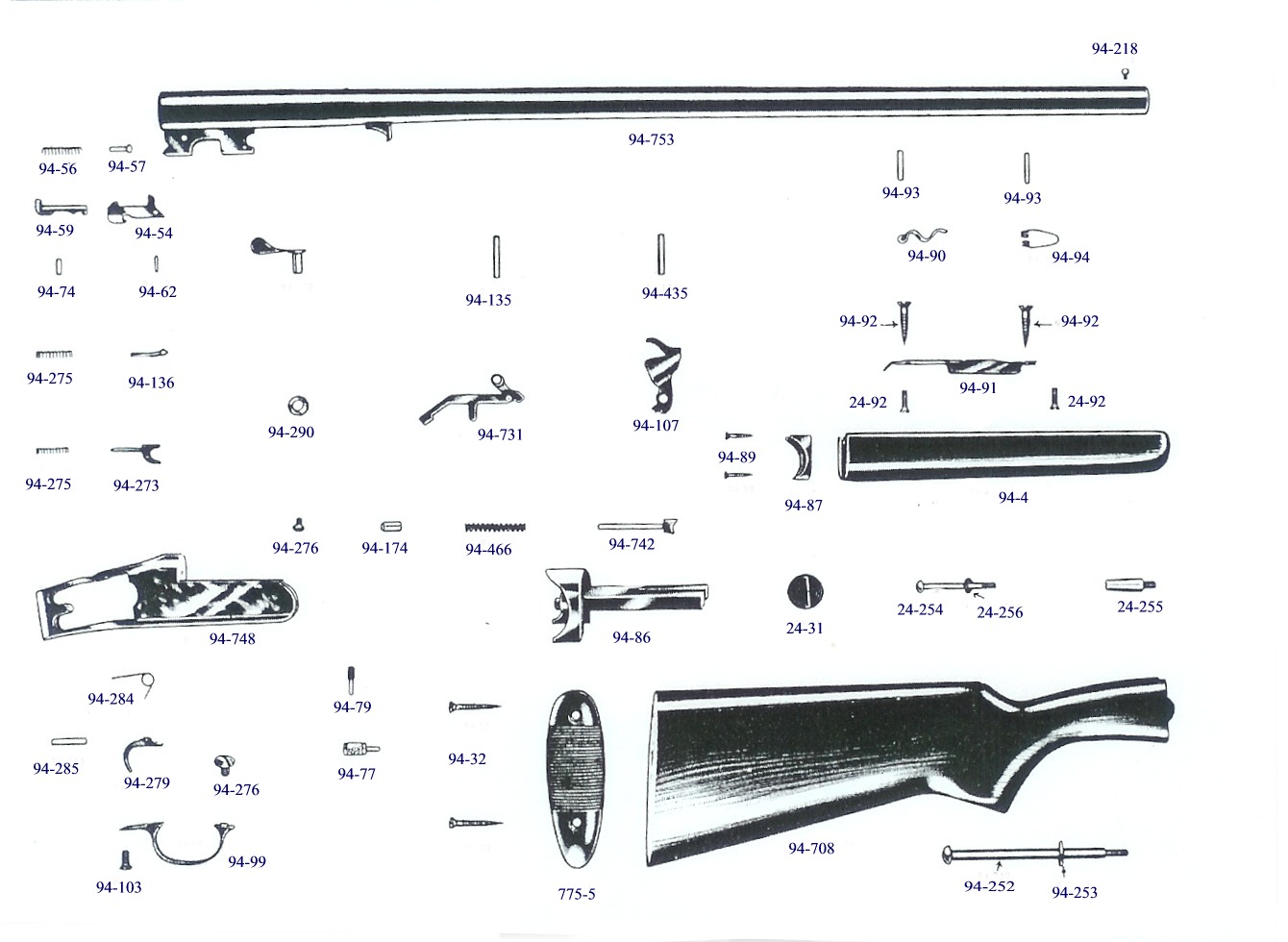
The illustration shown below was scanned off a Savage factory parts list, using factory reference numbers, which are converted to factory part numbers. This is important as about all obsolete parts suppliers use ONLY factory or closely associated numbers where ever possible so everyone is on the same page.
Note, for some of the older firearms,
many over 100 years old, the factories never used what we now know as assembly
drawings, but just views of many of the component parts & possibly randomly
placed
as seen below
|
The parts listed below are for your
identification purposes only. The author of this website DOES NOT have any parts. |
The illustrated parts shown here, are from original factory parts list of about 1950 & use factory party numbers
Art Spiegelman’s “Maus” is a Pulitzer Prize-winning graphic novel that has been widely acclaimed for its unique and powerful portrayal of the Holocaust. The book, which was first published in 1986, tells the story of the author’s father, Vladek Spiegelman, a Polish Jew who survived the Nazi concentration camps during World War II. In this article, we will explore the significance of “Maus” and why it is an important work of literature that continues to resonate with readers today.
One of the most significant impacts of “Maus” has been its role in establishing the graphic novel as a legitimate literary form. The book has helped to demonstrate that comics can be used to tell complex and serious stories, and has paved the way for other graphic novelists to explore similar themes.
Exploring the Holocaust through Comics: A Review of Art Spiegelman’s “Maus” PDF** art spiegelman maus pdf
If you’re interested in reading “Maus”, a PDF version is a convenient and accessible option. Whether you’re a scholar, a student, or simply a reader who is interested in learning more about the Holocaust, “Maus” is an important work of literature that is well worth reading.
The story is told through a series of interviews between Art Spiegelman and his father, which are interwoven with flashbacks to Vladek’s past. The narrative is presented in a non-linear fashion, jumping back and forth between different periods of Vladek’s life. One of the most significant impacts of “Maus”
Spiegelman was born in 1948 in Stockholm, Sweden, and grew up in the United States. He began his career as a cartoonist in the 1970s, and has
One of the most striking aspects of “Maus” is its use of visual imagery. Spiegelman uses a range of techniques, including cartoon-style illustrations and symbolism, to convey the horrors of the Holocaust. The characters in the book are depicted as animals, with Jews represented as mice, Germans as cats, and Americans as dogs. This use of anthropomorphic animals allows Spiegelman to explore complex themes and emotions in a way that is both accessible and powerful. Whether you’re a scholar, a student, or simply
“Maus” is significant for a number of reasons. Firstly, it is one of the first graphic novels to deal with the Holocaust, and it has helped to establish the medium as a legitimate form of literary expression. The book has also been praised for its honest and unflinching portrayal of the Holocaust, which has helped to raise awareness of this important historical event.
Note that extractors for guns made prior to 1950 were
.435 wide at the top, while the later ones were .308.
C
opyright © 2005 - 2020
LeeRoy Wisner with credit given for original illustrations. All
Rights Reserved
Back to the Main Ramblings
Page
Originated 11-03-2005 Last updated
11-08-2020